
The latest ZEHID summit covered key learnings from the implementation phase of the project and highlighted remaining issues that still need to be addressed. Each consortium led sessions throughout the day focusing on different aspects of the transition, giving honest insight into the realities experienced so far.
Written by multi-award-winning international pan-automotive journalist, Trinity Francis.
Alistair Barnes, senior programme manager – land and maritime transport at Innovate UK said, “The direction of travel is clear. But what strikes me is that there is so much uncertainty around what remains and how exactly we get there. That’s exactly why today’s conference matters. It’s to help us collectively work out those practical pathways.”
Whereas the deployment of eHGVs and infrastructure was once theoretical, it’s now a reality that raises questions about the next steps. Barnes noted key questions include how the transition is scaled, how we make sure infrastructure supports operational and financial goals, how do we continue to collaborate effectively and how we bring everyone along on the journey.
Key lessons from depot charging installations
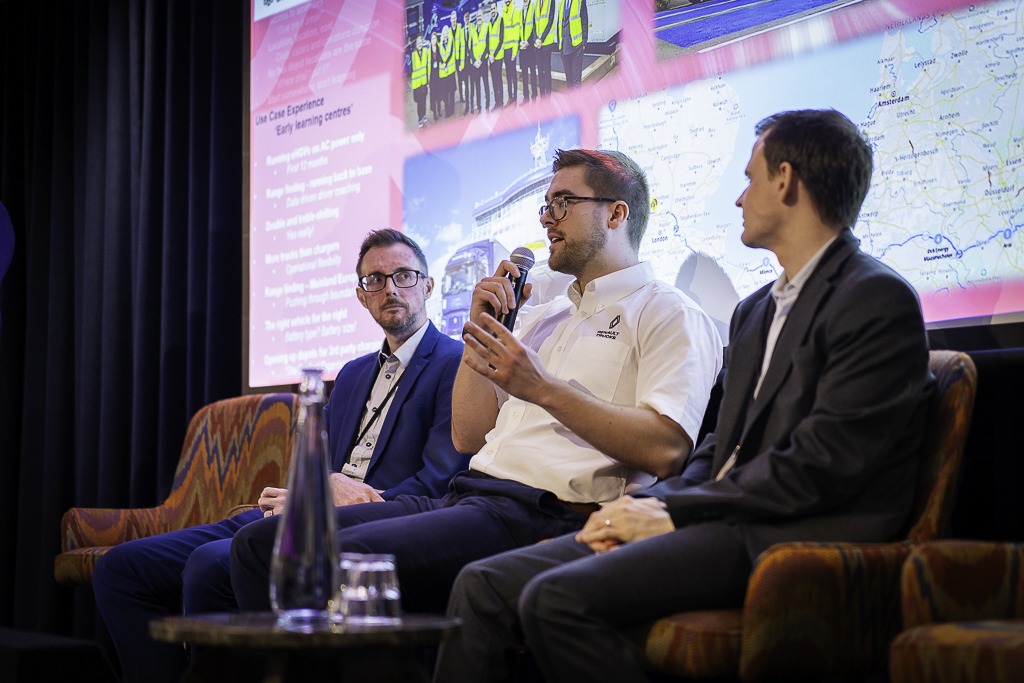
One of the most important elements of the ZEHID programme is information sharing between members and the wider industry. Neil Durno, head of partnerships at Voltempo hosted a session on existing depot charging sites and what needs to be considered to open these sites up to third party users.
Speakers throughout the day emphasised the fact that every site across the project has individual challenges and opportunities which result in the need for bespoke solutions – there is no ‘one size fits all’.
Chris Jennings,transport and decarbonisation manager at Kuehne + Nagel said, “We had the opportunity of installing some AC charging first as we recognised how long the DC charging would take to get over the line with the DNOs, the legalities and the landlord conversations. It took a lot longer than we ever expected, so I’m glad we pushed the button on the AC charging, it got us going quite quickly.”
While other panels discussed delays due to things like wildlife surveys, Jennings explained that Kuehne+ Nagel’s delays centred around legal challenges and contracts.
Now infrastructure is live, Jennings and Durno explored how sites can be opened up to share charging since this is an additional revenue stream and way to support eHGV adoption across the industry. Jennings said, “We’re committed to our landlord to have a traffic plan for the number of vehicles that access and egress. We’ve had to feed into them what our expectations and projections are to amend that plan.
“We’re a TAPA A secure site, so we have to know exactly who’s coming onto site and what they’re here for, so we would need a booking process.” As well as a smooth booking system, Jennings noted the need to prioritise Kuehne + Nagel’s charging requirements and understand liability issues if a charger is damaged by a third party, for example.
Durno explained that other aspects to consider are making sure drivers have access to facilities if they’re having a break while charging. Additional complexities include things like PPE requirements for certain sites.
What’s the right charging solution?
Whether it’s depot charging, shared charging or public charging, the right mix of charging solutions will vary depending on operational specificities. Discussing how depot charging will evolve as eHGV deployments scale, Jennings said, “I personally think depot charging is going to be a jigsaw piece. It’s a big part of the starting block because of that warm fuzzy feeling you’ve got that you’re in control of your electric.
“Where I think we will go with our depot is that we probably won’t put much more charging infrastructure in our depot. We’re on an industrial estate and the industrial estate needs to start having shared charging. We need charging at our customer sites and we’re engaging with our customers now about putting in quick solutions so we can charge while we’re loading and unloading. They’re all pieces of the puzzle that I think are going to play a big part in how we electrify the industry.”
Considering locations where the grid is restricted, Michael Boxwell, founder and corporate development officer at Voltempo said, “Battery storage combined with an EV charger is important going forward because there are lots of sites where you can get a low power grid connection, you can’t necessarily get a big one. Then you can charge your battery from solar or from the grid.
“What we’re looking at is roughly a 400kWh battery pack with a 200kW charger. You can only charge one or two vehicles at the same time using that, but you also have the benefit of being able to buy energy at lower cost during off-peak periods, and keep your running costs down in that way. So that’s something which we’ve been modeling. We will have those facilities in use this year, which is great.”
The best short, medium and long term charging solutions first rely on evaluating current capacity. Peter Hughes, head of engineering at Voltempo explained, “It varies by every single site that we go to but understanding where you can potentially make use of existing power is the first step.
“Then it’s engaging early and building partnerships with the iDNOs, the DNOs and the ICP who will ultimately do the work for you. Having those strong partnerships and understanding how to progress through each of the stages of the design is critical to ensuring that the project delivers successfully.”
How do drivers feel about eHGVs?
Outside of infrastructure challenges, feedback from fleets about driver reactions has been overwhelmingly positive. Jennings found that drivers who drive electric cars typically take to eHGV driving much quicker since they have more experience optimising efficiency.
Jack Millington, energy transition manager at Renault Trucks UK explained that through ZEHID Renault has been able to tailor its driver training. He explained, “Those data insights have allowed us to see the same improvement that we saw over six months within six weeks. For the same driver we’re seeing 15% better efficiency from their day one to six weeks later because we’ve got that learning.”
Jennings added, “The drivers love the vehicles. It doesn’t matter what OEM the vehicle is from, they love them. They’re comfortable, quiet and they love the torque delivery. At the end of the day they’re less fatigued and don’t smell of diesel. eHGVs are going to be a recruitment and retention tool in the future.”