
The Motor Transport Decarbonisation Summit is an annual opportunity to track the progress of the industry’s transition to zero-emission solutions. It brings together operators, infrastructure providers, OEMs, trade bodies, academics and industry experts to explore the intricacies of decarbonisation.
Written by Trinity Francis
This year, speakers noted that the hardest step in their respective journeys has been going from a fully diesel fleet to introducing their first eHGV. Shared charging was seen as a crucial way to derisk the transition for fleets deploying their first electric trucks, but infrastructure remains a stubborn barrier across the industry.
Up until now, findings from each ZEHID consortium have been published separately, but now the programme is in the demonstration phase, the first ZEHID annual report was published at the Summit. Alistair Barnes, senior programme manager – land and maritime transport at Innovate UK, said, “There’s a huge amount of learning on an individual level across various operators involved. It’s our duty to try and spread that out.
“One aspect that I think is important to reflect on is that what we’re trying to do in this programme is to take the perceived risks around decarbonisation and understand where they are actual risks or just perceived risks. If we can separate that out, we can reduce the uncertainty.”
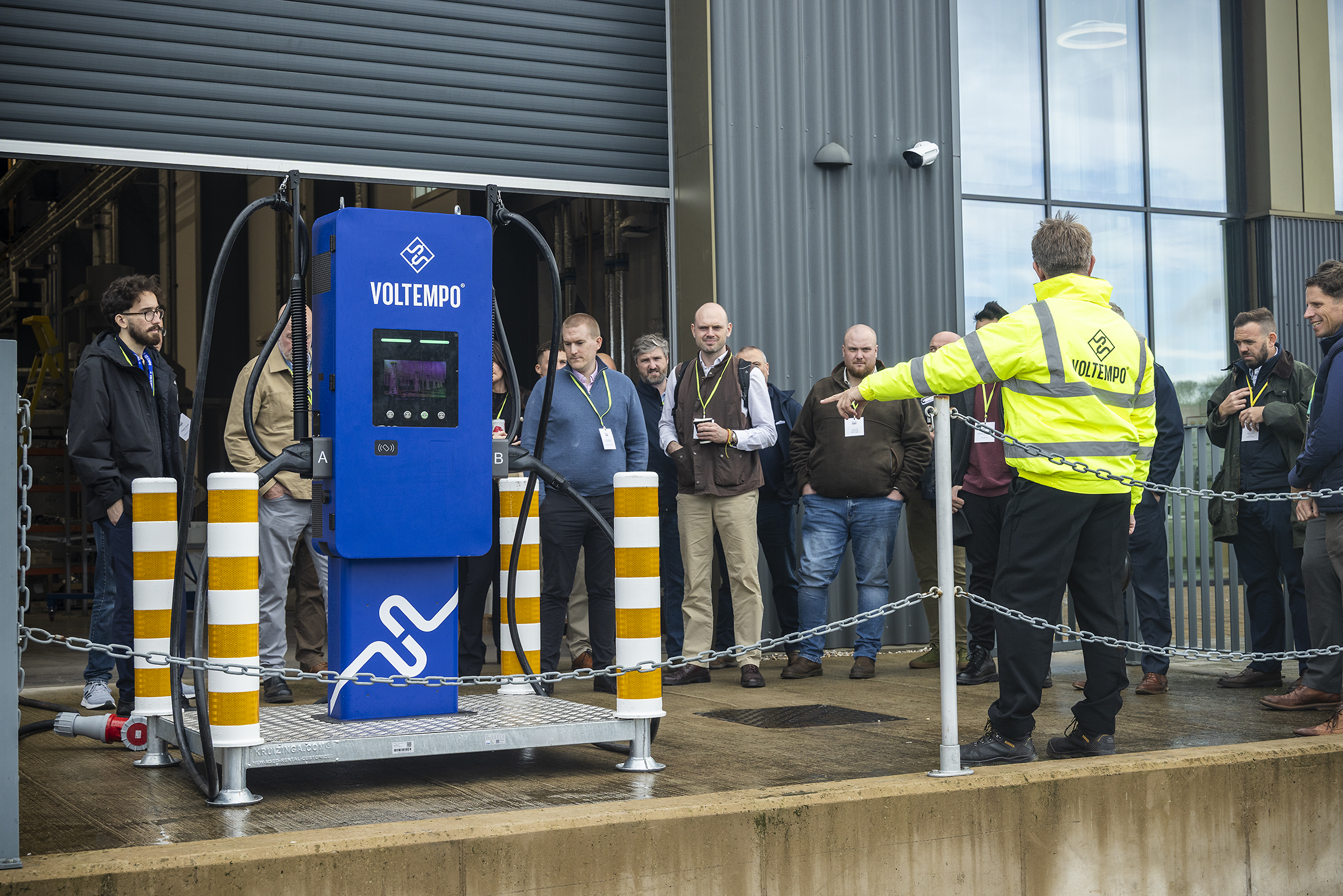
Delays due to legals, grid connections and land permissions have unfortunately been a certainty for nearly every operator installing charging infrastructure. To help alleviate this, Voltempo showcased its mobile charging solution on the first day of the Summit. The unit has in-built bollards, can be moved around the yard with a forklift and attached to a 63 amp commando socket to charge vehicles at 40kW.
Michael Boxwell, founder and corporate development officer at Voltempo, said, “One of the big learnings from eFREIGHT 2030 has been that getting the grid connection and getting energised can take an awful lot of time. For our mobile charger, you could get your electrician to come and set up a connection. You might need a minor grid upgrade, but once that’s set up, and that should be a few weeks, you can have your charging system in really quickly.
“It’s not a big scaled megawatt charging system, but it means you can get going pretty much straight away. As quickly as you can order the truck, you can have the charging infrastructure in. That size of charging is good for a couple of trucks. You can get it installed pretty much anywhere in the UK.”
Infrastructure is key so fleets can start using and pushing their eHGVs. Barnes said, “Infrastructure really matters because range is not the same as reach. In some ways, vehicle range doesn’t matter too much if you’ve got infrastructure in the right place. As we’ve seen proved by Kuehne+Nagel earlier in the year when they took a vehicle to Germany from East Midlands Gateway, using both depot and public charging.”
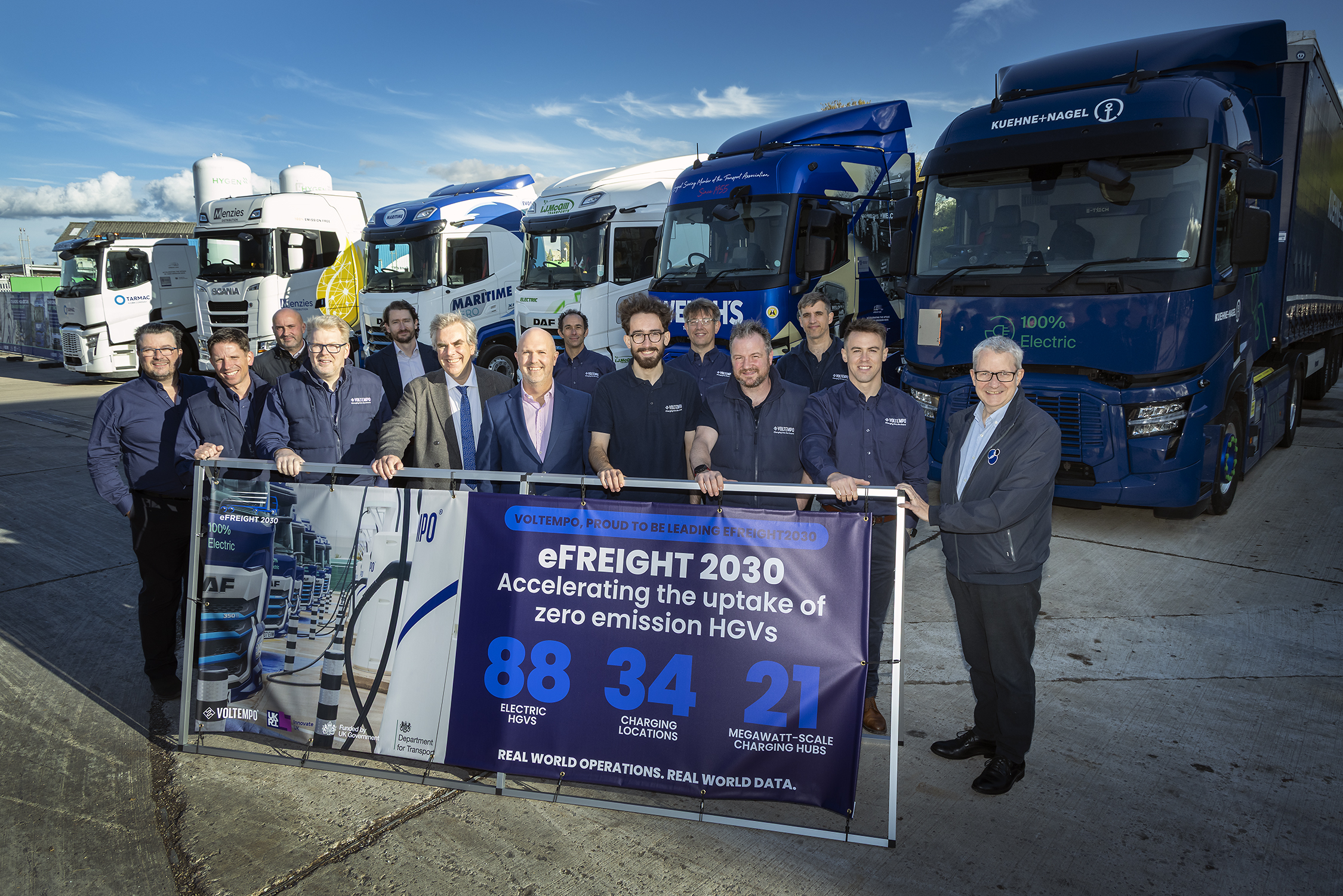
For the fleets that have been able to get their infrastructure up and running, utilisation is the next hurdle to make sure the investment is recouped as quickly as possible. Chris Welch, managing director at the Welch Group and Neil Durno, head of partnerships at Voltempo, hosted a session looking at the economics of shared charging.
Welch said, “I look at it as a revenue centre, or look at it from the point of view of what it does for our own fleet as it grows. At the moment, because of the size of the infrastructure we’ve put in, it costs us more than running diesels. Price parity is about 37p/kWh, we are up at 40p/kWh because of the sheer amount of money we’ve had to put in.”
This is where shared charging is expected to help the fleet to achieve parity with diesel before generating significant savings. By 2027, Welch plans to be running 12 eHGVs which equates to 18% of the company’s fleet. With 25 van charging and two eHGV charging sessions a day from visiting operators, Welch anticipates a £75k annual saving compared to diesel. Without guest charging, this flips to a loss of £9k compared to diesel, so the shared model is critical for profitability.
By 2030, Welch hopes to increase guest charging sessions to at least 60 vans and five trucks a day. Combined with 35 of Welch’s own eHGVs, the annual saving against diesel is projected to hit £391k. This figure is modelled to more than double in the following five years to 2035, by which time the entire fleet of 65 trucks should be electric. By then, the goal is to host at least 75 van charges and 10 visiting eHGV charges a day.
Speaking on the ‘Building confidence in the electric truck market’ panel the following day, Adam Purshall, fleet, procurement and operational systems director at Menzies Distribution Solutions, also noted the benefit of shared charging for both the home fleet and other operators. He said, “Utilisation is key. It’s an expensive asset, we want it running day and night, seven days a week, wherever we possibly can.
“We’ve heard from various people about the costs that are very, very significant in getting power into these sites, so we have to use it. Our approach is that our core fleet has got to be primary, but outside of that, there are lots of growth opportunities to open that availability to anybody that wants to use it. I think that has to be the way that we collaborate.”